
Materials Return to Safe Moisture Levels
Structural Drying & Dehumidification in Waco for water-damaged properties requiring monitored moisture removal from building materials
Visible water removal marks only the first step in flood recovery—moisture absorbed into framing lumber, subfloors, drywall, and insulation remains trapped inside structural cavities for days or weeks without targeted airflow and humidity control, leading to warping, microbial growth, and adhesive failure in finishes installed prematurely over incompletely dried substrates. Industrial drying equipment deployed by Lone Star Flood Restoration in Waco uses calibrated dehumidification and air movement to extract moisture from building materials, monitored daily with pin-type and non-invasive meters until wood framing drops below 15 percent moisture content and drywall reaches manufacturer-specified thresholds. You see floors that no longer buckle or feel spongy underfoot, walls that return to room temperature instead of staying cool from evaporating moisture, and paint that adheres without bubbling or peeling once substrates stabilize at safe dryness levels.
Moisture monitoring uses penetrating pin meters to measure water content deep inside framing and non-invasive scanners to map moisture distribution across wall and ceiling surfaces without creating probe holes. Wall cavity drying circulates conditioned air behind drywall through small injection ports, accelerating evaporation from insulation and studs without requiring full demolition of finished surfaces. Hardwood floor drying prevents cupping and crowning by positioning air movers to direct airflow across board surfaces while dehumidifiers extract water vapor before it condenses on cooler subflooring beneath, maintaining precise humidity levels that allow wood to release moisture gradually without stress cracking.
Request a moisture assessment to map wet zones in your property and establish drying equipment staging tailored to your specific water intrusion pattern.
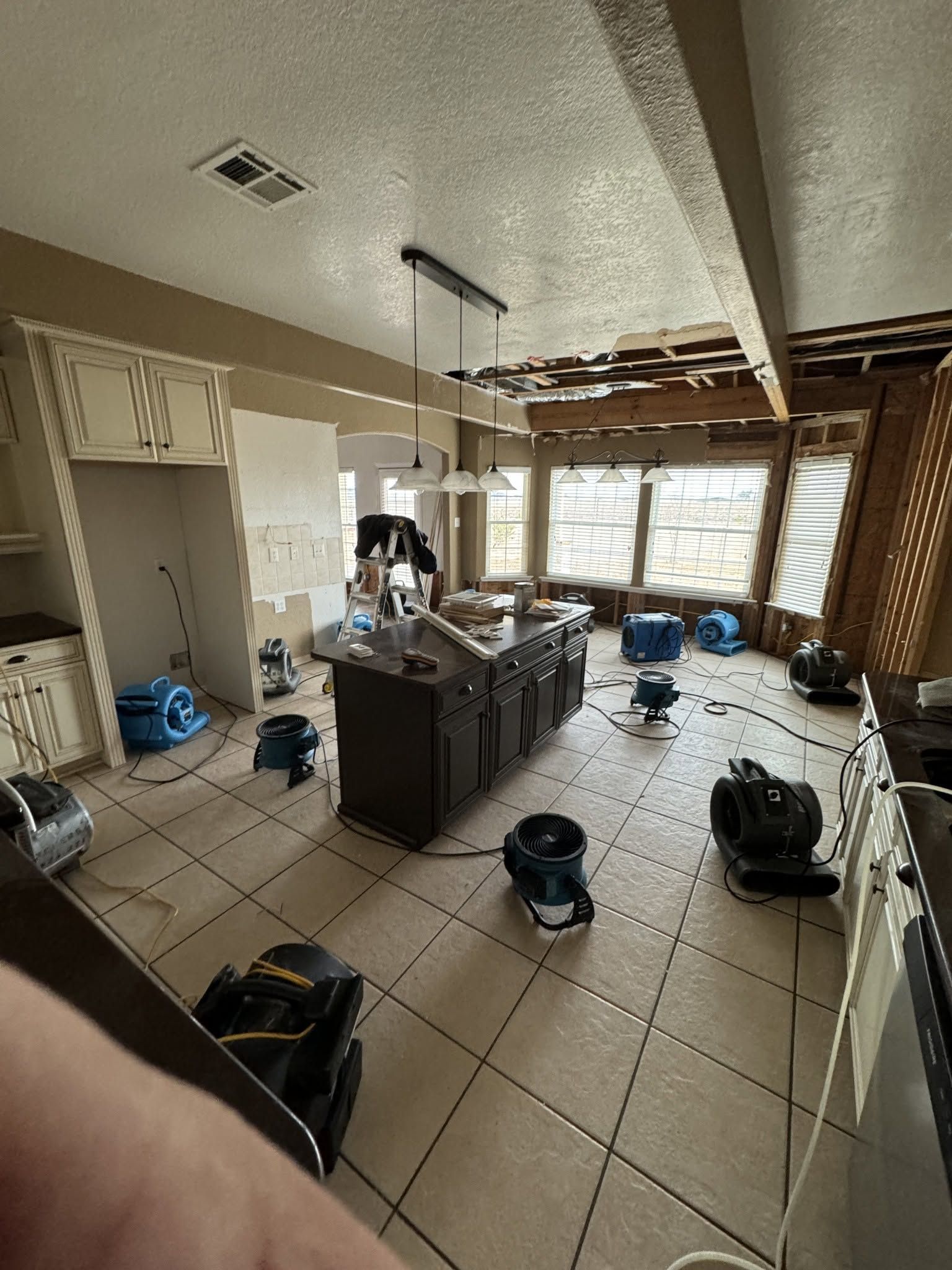
What Proper Structural Drying Requires
Effective drying depends on controlling four environmental factors—temperature, humidity, airflow, and time—using industrial dehumidifiers that extract dozens of gallons per day from indoor air and air movers positioned to create circulation patterns targeting saturated zones. Dehumidifiers work most efficiently when indoor temperature stays above 70 degrees, accelerating evaporation and preventing condensation on cold surfaces that would redistribute moisture instead of removing it. Humidity control maintains indoor relative humidity between 30 and 50 percent during active drying, low enough to draw moisture from wet materials but not so low that wood framing shrinks excessively or drywall edges crack from rapid dehydration.
Lone Star Flood Restoration adjusts equipment daily based on moisture meter readings—adding air movers to stubborn wet spots, relocating dehumidifiers to areas with rising humidity, and documenting progress with logs showing moisture content trends over the drying cycle. Once structural materials reach target moisture levels, typically three to seven days depending on saturation depth, you notice that damp odors dissipate, floor surfaces are no longer cold to touch, and condensation stops forming on windows as indoor humidity stabilizes at normal levels.
Drying cannot proceed faster than materials can release absorbed moisture—attempting to accelerate the process with excessive heat risks damaging finishes, while removing equipment prematurely leaves residual moisture that supports mold growth or causes dimensional changes in framing as slow evaporation continues. Monitoring continues until two consecutive days show no further moisture reduction, confirming materials have reached equilibrium with ambient conditions and are ready for reconstruction or finish installation.
Answers to Frequent Drying Questions
Homeowners managing water damage want to understand equipment operation, drying duration, and how moisture levels are confirmed before restoration proceeds.
What types of equipment run during structural drying?
Industrial dehumidifiers remove water vapor from the air, axial and centrifugal air movers create targeted airflow across wet surfaces, and specialty equipment like drying mats or injectidry systems address confined spaces such as under hardwood floors or inside wall cavities where conventional air movers cannot reach.
How long does structural drying take after a flood?
Drying timelines depend on materials affected and saturation depth—surface water on tile or concrete may dry within 24 hours, while soaked drywall and insulation typically require three to five days, and hardwood subfloors or dense framing lumber can take a full week to release absorbed moisture completely.
Why does drying require daily monitoring instead of just running equipment?
Moisture distribution changes as drying progresses—areas that initially read dry may show elevated readings as water migrates from deeper layers, requiring equipment repositioning and extended drying time in zones that were not saturated when work began.
How is moisture measured inside walls without removing drywall?
Pin-type meters drive probes through drywall into framing to measure moisture content in lumber behind the surface, while infrared cameras and non-invasive scanners detect temperature differentials and moisture presence without penetrating finishes—techniques used frequently in Waco properties where preserving finished walls reduces reconstruction costs.
What happens if reconstruction starts before materials fully dry?
Flooring installed over damp subfloors traps moisture that causes adhesive failure, buckling, or mold growth beneath the new finish, and drywall compound applied to wet framing will not cure properly, leading to cracking and finish failure within weeks—complete drying prevents these costly rework scenarios.
Lone Star Flood Restoration provides final moisture documentation showing all building materials reached safe thresholds before drying equipment is removed, supporting insurance requirements and ensuring reconstruction proceeds on stable, dry substrates. Schedule an equipment consultation to review drying strategies suited to your property's specific water damage conditions and material types.
